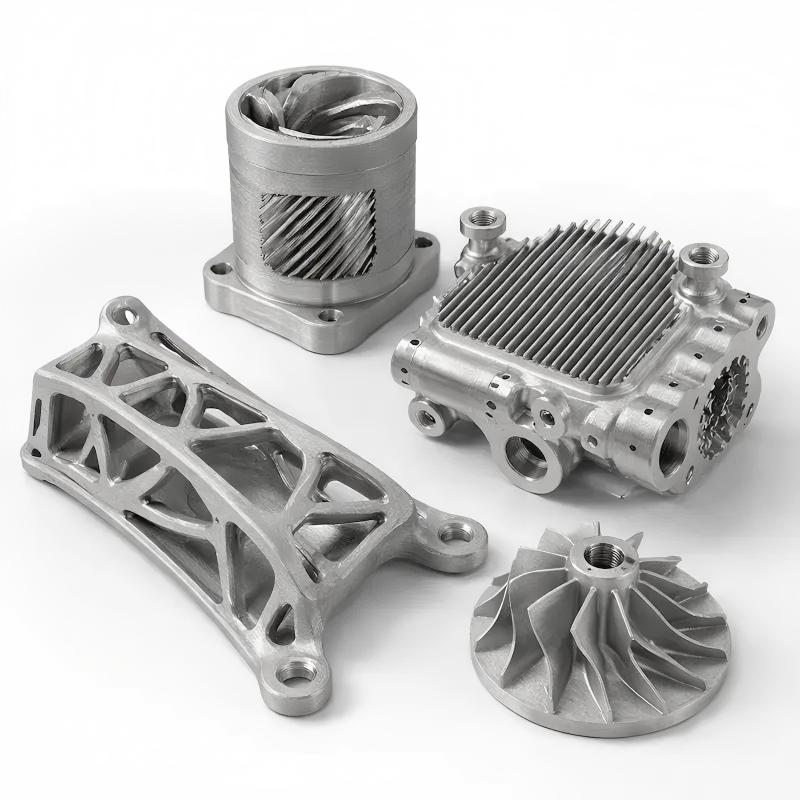

Product Introduction
Aluminum alloy AlSi10Mg (SLM)
The aluminum alloy AlSi10Mg is suitable for projects featuring "lightweight design + heat dissipation/thermal conduction + integrated forming of complex structures", such as heat sinks, lightweight brackets, and components with complex flow channels. Metal 3D printing enables the integration of multiple parts into one, reducing assembly and welding processes. Its advantages become more prominent when traditional CNC machining struggles to handle complex internal structures. |
Key parameters and order requirements
| Before placing the order, please confirm the following: ① Whether the primary objectives involve lightweight design, heat dissipation, or thermal conductivity (which dictates structural strategies and post-processing priorities); ② Whether critical assembly holes, datum surfaces, or sealing interfaces are present (tolerances and reference datums should be specified); ③ Whether thin walls, long overhangs, or large planar surfaces are included (support strategies and deformation control must be evaluated); ④ Whether threaded assemblies are required (thread specifications and quantities should be clearly defined, with tapping recommended for enhanced assembly stability). Typical parameter ranges include: dimensional accuracy ±0.1 mm, minimum wall thickness 0.5 mm, temperature resistance 200°C, tensile strength 320–460 MPa, and density 2.65 g/cm³. Actual outcomes may vary depending on equipment, orientation, support strategy, and post-processing. For projects with high assembly precision or aesthetic requirements, details should be noted in remarks and undergo a Design for Manufacturability (DFM) review in advance. |
| technology | SLM Metal 3D Printing (Aluminum Alloy AlSi10Mg) |
| Material Positioning | Lightweight Design + Integrated Thermal Dissipation/Conduction + Complex Structures via Monolithic Forming Process; Suitable for Both Functional Components and End-Use Parts |
| Size Tolerance (Reference) | ±0.1 |
| Minimum Wall Thickness (Reference) | ≥0.5 mm |
| Temperature resistance (reference) | 200℃ |
| Tensile Strength (Reference) | 320–460 MPa |
| Density (Reference) | 2.65 g/cm³ |
| Assembly Holes and Threads | Threads are generally recommended to be formed by tapping to ensure more consistent assembly quality; for critical mating/location holes, it is advisable to provide 2D annotations and plan secondary machining paths when higher assembly precision is required. |
| Post-processing | Sandblasting, CNC Machining (Tapping), Spray Painting, Polishing, Plating, Passivation, Anodizing, Laser Engraving, Screen Printing. |
| Typical Delivery Time | Correlates with structural complexity, quantity, support requirements, and post-processing needs; a definitive delivery timeline and expedited options are provided upon file upload. |
postprocessing
| Sandblasting (Surface Uniformity and Feel) | Drilling (for reliable assembly) |
| This product is designed to enhance surface uniformity and visual quality in metal 3D printing, achieving a more industrially consistent appearance. For components with specific aesthetic requirements, it is recommended to specify the desired finish surfaces and roughness preferences. | For enhanced stability in threaded assembly quality, please specify the thread specifications (e.g., M value), quantity, positioning, and mounting methods (e.g., screw/bolt/fitting) in the remarks. |
Why choose aluminum alloy AlSi10Mg (for metal 3D printing)
| Lightweight and more user-friendly | The heat dissipation / heat conduction structure is more compatible | Complex structure one-piece molding | It can be coordinated with assembly requirements |
| The component demonstrates optimal suitability for lightweight structural design and integration approaches, enabling a significant reduction in overall weight while maintaining requisite strength characteristics—a prevalent feature in brackets, enclosures, and structural elements. | This method is particularly suitable for radiators, conductive bases, and components incorporating heat-dissipation fins and intricate heat-exchange structures, enabling the fabrication of more complex internal and external thermal management configurations. | This approach enables the integration of multiple components into a single unit, reducing welding/assembly points and enhancing structural integrity, particularly advantageous for intricate internal configurations. | Enhancing Threaded Assembly Reliability via Tapping Operations; For Key Boreholes and Mating Surfaces, Optimized Manufacturing and Subsequent Processing Strategies Can Be Planned During the Design Phase |
More suitable (recommended) | It is not recommended to simply use (suggestion: change the plan) |
|
|
Design and DFM Recommendations
Minimum Wall Thickness and Large Flat Area Control: The recommended minimum wall thickness is 0.5 mm. Thin-walled large planar structures and long cantilevered features are prone to deformation; it is advisable to incorporate reinforcing ribs, fillets, and smooth transitions. |
Internal flow channels must be designed to facilitate powder discharge. Reserve dedicated powder-ventilation apertures and clearing paths to avoid fully enclosed cavities. For complex channel configurations, a Design for Manufacturability (DFM) review is recommended prior to production. |
Recommended Planning Strategy for Keyhole/Datum Surfaces: For assemblies requiring priority on dimensional accuracy, it is advisable to incorporate 2D annotations and plan secondary machining paths for critical hole positions. |
| Recommended Threading Method for Tapping: Directly formed threads are more susceptible to inconsistency in quality; tapping offers greater stability. Please specify the M specification, quantity, and location. |
Appearance surfaces should be defined in advance: Blasting can enhance uniformity; however, functional/sealing surfaces must avoid roughening. Please label appearance surfaces and functional surfaces accordingly. |
Compared with common metal 3D printing materials
| materials | core advantage | Mainly applicable | Not Applicable |
| Stainless Steel 316L (SLM) | Enhanced corrosion resistance, suitable for application in humid/saline environments and compatibility with general metal terminal components | Corrosion-Resistant Functional Components, End Parts, and Complex Structural Components | For projects where lightweight design and thermal conductivity are the primary objectives (AlSi10Mg is more suitable) |
| Titanium alloy TC4 (SLM) | High strength-to-weight ratio, corrosion-resistant, performance-oriented | High-end structural components, lightweight terminal parts, and reliability-prioritized parts | Budget-sensitive, general corrosion-resistant requirements (316L is more cost-effective) |
| Mold steel 1.2709 (SLM) | High strength and good heat treatment performance, suitable for jigs/molds type applications | Jigs, fixtures, mold inserts, high-strength structural components | High corrosion resistance requirements (316L is more suitable) |
| Nickel-based superalloy (SLM) | High temperature resistance, suitable for high-temperature working conditions | High-temperature functional components, thermal environment verification documents | Only corrosion resistance / general strength requirements (316L offers a more balanced solution) |