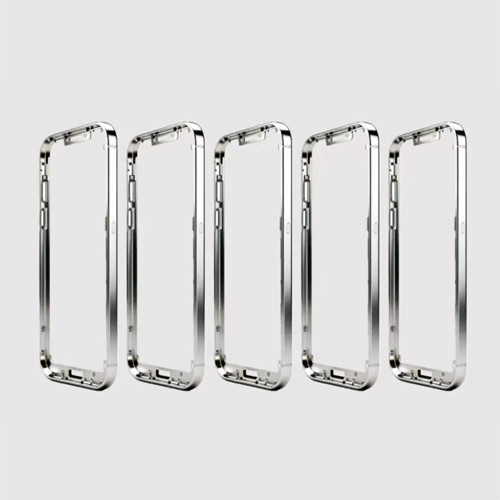
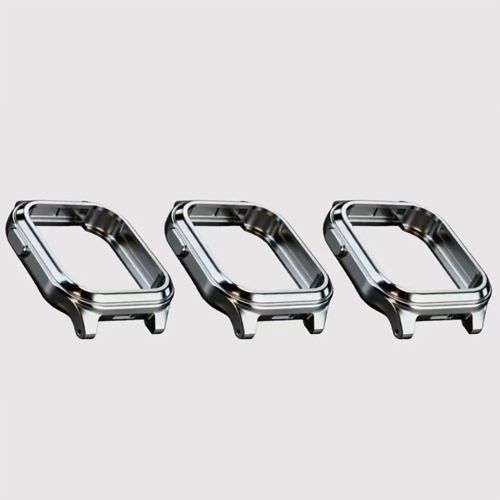
Product Introduction
Application case
 |  |  |
| Mid-frame of smartwatch | VR Eyewear Frame Structure | Charger Plug Terminal |
 |  |  |
| Hinge Cover Plate | Mid-frame of smartwatch | Foldable phone hinge shaft cover |
Industry Overview
Consumer electronics are increasingly exhibiting a strong demand for personalized customization. Metal 3D printing technology not only responds swiftly to design requirements by producing components with intricate internal structures and refined surfaces, but also demonstrates significant advantages during the product development phase. Compared to traditional manufacturing processes, which often suffer from prolonged cycles and limited flexibility, metal 3D printing enables rapid prototyping, substantially enhancing R&D efficiency. Furthermore, it offers an effective solution to challenges such as the low thermal conductivity and high machinability difficulty of titanium alloys, providing an ideal option for lightweight design in consumer electronics—combining high strength with reduced weight.
Advantages of Metal 3D Printing
1. By utilizing near-net-shape fabrication for direct-formed components and combining CNC machining for precision finishing of decorative and assembly surfaces, this approach significantly streamlines the production workflow and substantially reduces both the manufacturing complexity and cost associated with stainless steel and titanium alloy components.
2. It enhances functional integration within components, reduces the total number of parts, and enables the fabrication of lighter and thinner structural designs.
3. This method facilitates mass production with higher efficiency and more consistent quality output.
2. It enhances functional integration within components, reduces the total number of parts, and enables the fabrication of lighter and thinner structural designs.
3. This method facilitates mass production with higher efficiency and more consistent quality output.
The working principle of SLM metal 3D printing
Using metal powder as raw material, the 3D model data is sliced in the Z direction into two-dimensional planar graphics. The two-dimensional planar graphics are sintered and formed on the powder bed by controlling the laser path with a galvanometer, and then the two-dimensional graphics are stacked to form a three-dimensional part.

SLM Metal 3D Printing Materials and Properties(as-heat-treated condition)
| Material type | Material designation | Tensile Strength / MPa | Yield Strength/MPa | Ductility/% | ||
| X-axis and Y-axis direction | Z-axis direction | X-axis and Y-axis direction | Z-axis direction | |||
| aluminium alloy | AlSi10Mg | 456±30 | 440±30 | 311±30 | 270±30 | 8±2 |
| AlSi7Mg | 424±20 | 405±20 | 289±20 | 262±20 | ≥7 | |
| aldural | 541±15 | 515±15 | 520±15 | 475±30 | ≥10 | |
| titanium alloy | TC4 | 1040±90 | 1050±90 | 980±90 | 1000±90 | 14±4 |
| TA15 | 1118±100 | 1142±100 | 1064±100 | 1118±100 | 12±4 | |
| stainless steel | 316L | 678±20 | 650±20 | 427±30 | 418±30 | 51±10 |
| 304L | 600±50 | 597±50 | 353±20 | 352±20 | 55±10 | |
| 4J36 | 550±50 | 530±50 | 492±50 | 472±50 | 34 | |
| 17-4PH | 1110±50 | 1109±50 | 1073±50 | 1046±50 | ≥15 | |
| die steel | MS1(1.2709/18Ni300) | 1833±50 | 1805±50 | 1772±50 | 1739±50 | ≥7 |
| high temperature alloy | GH4169(In718) | 1400±50 | 1250±50 | 1250±50 | 1250±50 | 9~20 |
| GH3625 | 900±50 | 850±50 | 410±50 | 390±50 | ||
| GH5188 | 954±20 | 888±20 | 449±20 | 441±20 | 64±10 | |
| GH3536 | 878±50 | 885±50 | 548±30 | 549±30 | 37±10 | |
| GH4099 | 1215±50 | 1170±50 | 1047±50 | 988±50 | 30±5 | |
模具生产效率问