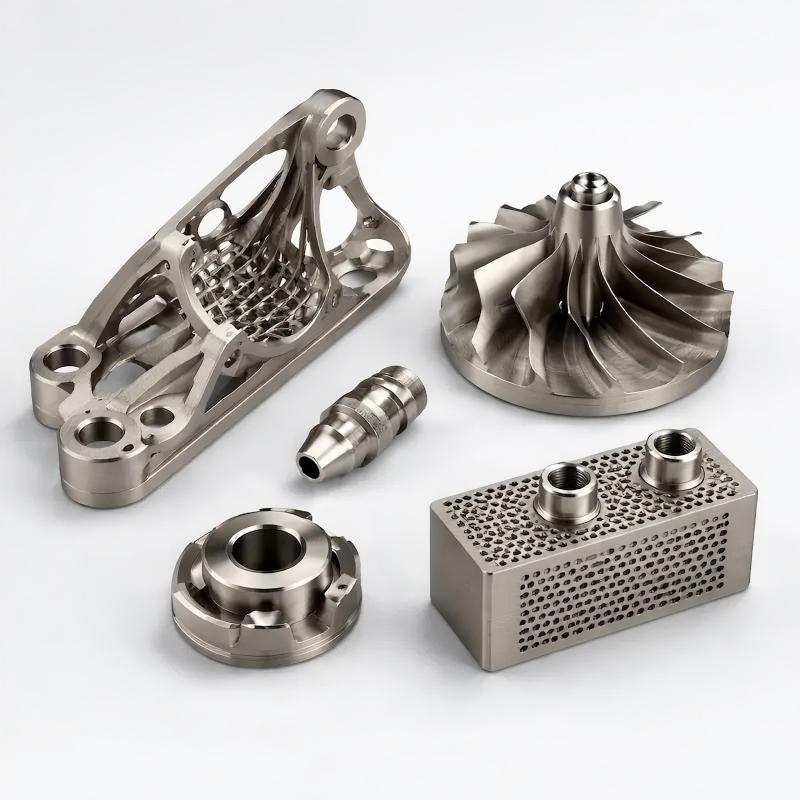

Product Introduction
Titanium alloy TC4 (SLM)
| TC4 titanium alloy stands as one of the most widely utilized high-performance titanium alloys in metal additive manufacturing, with key advantages encompassing a high strength-to-weight ratio, exceptional corrosion resistance, and superior reliability. When lightweight structural components, complex integrated geometries—aimed at minimizing assembly and welding requirements—or functional/end-use parts demanding stringent material performance are required, TC4 processed via Selective Laser Melting (SLM) often represents an optimal solution that prioritizes mechanical properties while ensuring engineering feasibility. |
Key parameters and order requirements
| Before placing the order, please confirm the following: ① Are there any key assembly reference points / mating holes (it is recommended to provide 2D annotations and tolerances)? ② Is tapping required (thread specification, hole depth and effective thread length)? ③ Do the appearance surfaces need to be sandblasted for a uniform texture (and acceptable surface roughness / texture)? ④ Are there any thin-walled / long and slender structures / large flat surfaces (which need to be evaluated for warpage, residual stress and support strategies). The parameters are within the common engineering range and are subject to the influence of equipment, placement direction, wall thickness distribution, and subsequent finishing strategies. If you have specific standards or acceptance criteria (such as critical hole positions/benchmark surfaces), please clearly indicate them in the remarks. We will conduct DFM analysis and provide risk warnings before quoting. |
| Technology | Selective Laser Melting (SLM) Metal 3D Printing (Titanium Alloy Ti-6Al-4V / TC4) |
| Colour | The inherent metallic finish (satin sheen can be achieved through more uniform sandblasting; target surface textures for cosmetic applications can be additionally specified) |
| Size Tolerance (Reference) | ±0.10 mm (Standard aperture; For critical holes/datum surfaces, it is recommended to specify dimensional tolerances or annotate "precision priority," which may be evaluated in conjunction with machining strategies.) |
| Minimum Wall Thickness (Reference) | ≥±0.5 mm (Suggested value; residual stress and deformation risks need to be evaluated for thin-walled/long and thin structures) |
| Minimum-value Aperture | It is recommended that the size for directly formed holes be ≥2.0–3.0 mm; for assembly holes or threaded holes, it is generally advised to leave allowances for secondary machining or tapping. |
| Typography/Texture | The height of raised characters shall be ≥ 0.5 mm; the depth of sunken characters shall be ≥ 0.3–0.5 mm; and the line width shall be ≥ 0.3–0.5 mm. (Note: Post-sandblasting, details may appear slightly softened; it is recommended to moderately increase these dimensions.) |
| Tensile strength | 900–1100 MPa |
| Temperature resistance | Approximately 350°C (For structural/functional validation under high-temperature conditions; specific applicability depends on operational environment and structural requirements) |
| Density | 4.43 g/cm³ |
| Surface roughness | In relation to orientation, support, or parameters; sandblasting can significantly standardize both appearance and tactile properties (although this should not be equated with achieving a mirror-like surface) |
| Accuracy class | Standard Precision / Accuracy Priority (Key Hole Positions/Datum Planes and Acceptance Criteria Must Be Defined in the Remarks) |
| Assembly enhancement | Support tapping for screw assembly; please specify the thread specification (e.g. M3/M4), quantity, hole depth and effective thread length; if it is a high-strength fastening/repeated disassembly scenario, it is recommended to provide the assembly conditions to evaluate a more stable structure and processing strategy |
| postprocessing | Sandblasting, CNC machining (thread tapping), painting, polishing, electroplating, passivation, anodizing, laser engraving, screen printing |
| Delivery Timeline Specification | It is related to volume, quantity, wall thickness distribution, support complexity and whether tapping is required; after uploading the file, a clear delivery date and the feasibility of expediting will be provided |
postprocessing
| Sandblasting (Consistent Texture) | Drilling (for reliable assembly) |
| Sandblasting can quickly achieve a more uniform matte appearance, reducing the visual difference between layer lines and support marks, making it suitable for enhancing the consistency of aesthetic surfaces and handheld parts. | Used for screw assembly and structural fixation. Please specify the thread specification, quantity, hole depth and effective thread length in the remarks. Providing 2D marking of key hole positions will be more conducive to accurate quotation. |
Why choose titanium alloy TC4 (SLM)
| High strength-to-weight ratio (lightweight priority) | Stronger corrosion resistance and reliability | Complex structure one-piece molding | Assembly may be feasible (sandblasting + tapping) |
| Achieving weight reduction while maintaining high strength performance, making it particularly suitable for high-end structural components, lightweight brackets, and performance-critical functional/final parts | It exhibits enhanced stability against moisture, perspiration, and standard corrosive environments, rendering it suitable for long-term usage or applications with stringent demands for material reliability | Conducive to integrating multiple components into a single unit, thereby reducing assembly and welding processes; demonstrates even more pronounced advantages for structures that pose significant challenges in traditional machining, such as those involving complex internal cavities or topology-optimized lightweight designs | Grit blasting is employed to enhance surface uniformity, while tapping is utilized for threaded assembly and structural fixation. Critical hole positions can be evaluated through a "precision-first" strategy to establish more stable machining solutions |
More suitable (recommended) | It is not recommended to simply use (It is suggested to change the material/process) |
|
|
Design and DFM Recommendations
For keyholes/reference surfaces, please provide 2D annotations: The "assembly reliability" of SLM depends on your definition of critical dimensions. It is recommended to supply PDF/DWG files with tolerance callouts or specify "prioritized precision" in the notes. |
Thin-Walled and Slender Structures: Minimize large planar surfaces with excessive thinness and extended cantilevers; incorporate ribs, transitional fillets, or employ segmented assembly where necessary to mitigate deformation risks induced by residual stress. |
Wall Thickness Uniformity and Transitions: Avoid abrupt changes in thickness and stress concentration at sharp corners; utilize fillet/chamfer transitions and maintain consistent wall thickness to facilitate stable forming and subsequent assembly. |
| Thread and Assembly Hole Strategy: It is recommended to reserve machining allowance for threaded holes and perform tapping operations. Please specify thread specifications, hole depth, quantity, and location to prevent assembly issues caused by insufficient hole depth or thread length. |
Surface Finishing and Shot Blasting Inspection: Shot blasting provides uniform texture but may soften fine details. If aesthetic surfaces are specified, define both the designated surfaces and acceptable texture standards to facilitate optimal positioning and processing strategies. |
Compared with common metal 3D printing materials
| materials | core advantage | Mainly applicable | Not Applicable |
| Stainless Steel 316L (SLM) | Enhanced corrosion resistance, suitable for application in humid/saline environments and compatibility with general metal terminal components | Corrosion-Resistant Functional Components, End Parts, and Complex Structural Components | For projects where lightweight design and thermal conductivity are the primary objectives (AlSi10Mg is more suitable) |
| Aluminum alloy AlSi10Mg (SLM) | Enhanced lightweight design, ideal for integrated molding of thermal dissipation/conductivity and complex structures | Heat Sinks, Lightweight Supports/Brackets, and Complex-Flow-Channel Metallic Components | Scenario Prioritizing High Corrosion Resistance (316L Offers Superior Stability) |
| Mold steel 1.2709 (SLM) | High strength and good heat treatment performance, suitable for jigs/molds type applications | Jigs, fixtures, mold inserts, high-strength structural components | High corrosion resistance requirements (316L is more suitable) |
| Nickel-based superalloy (SLM) | High temperature resistance, suitable for high-temperature working conditions | High-temperature functional components, thermal environment verification documents | Only corrosion resistance / general strength requirements (316L offers a more balanced solution) |